
Materials
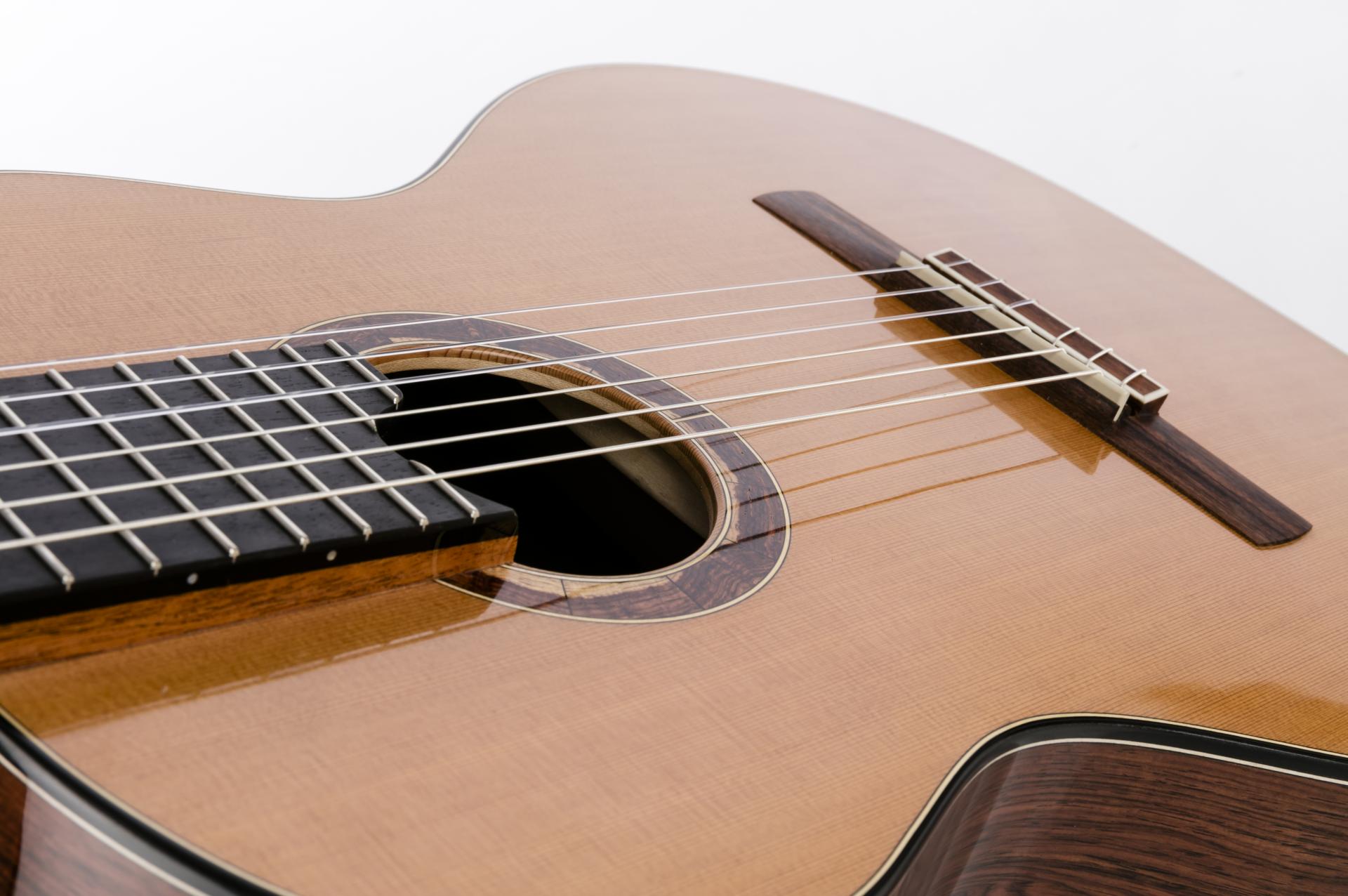
The most important material in guitar building is, of course, wood. Depending on how and what a guitarist plays, different types of wood must be selected to build the right guitar.
Once the guitar is (almost) finished, it is varnished, which also has an impact on the sound.
Not to be forgotten are the frets and nuts, which transmit the vibrations to the body of the guitar.
Good tuning machines are a delight for every guitarist. Most of my clients opt for the Scheller Tuning Machines, but I can also install many other tuners.
Wood
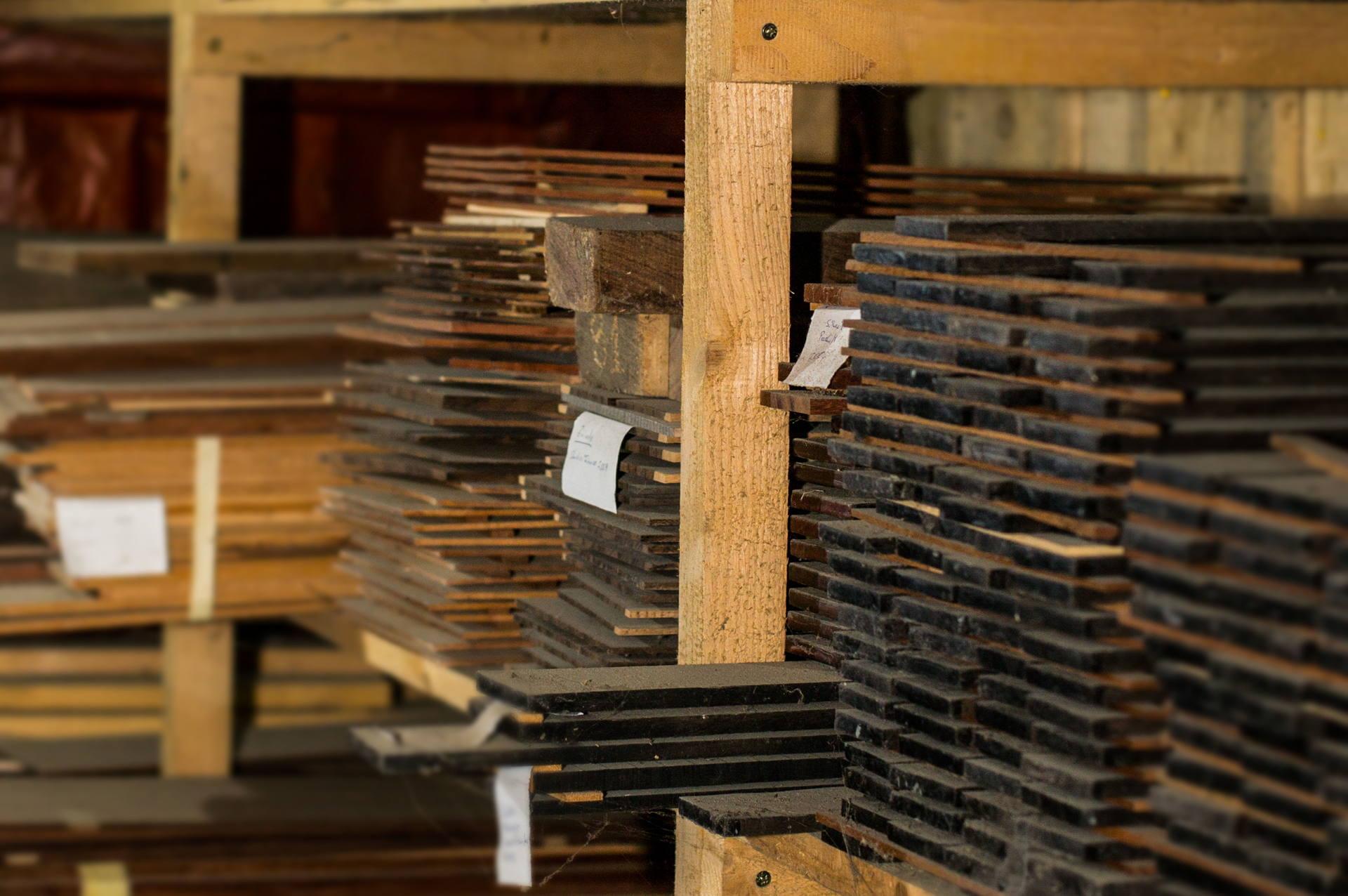
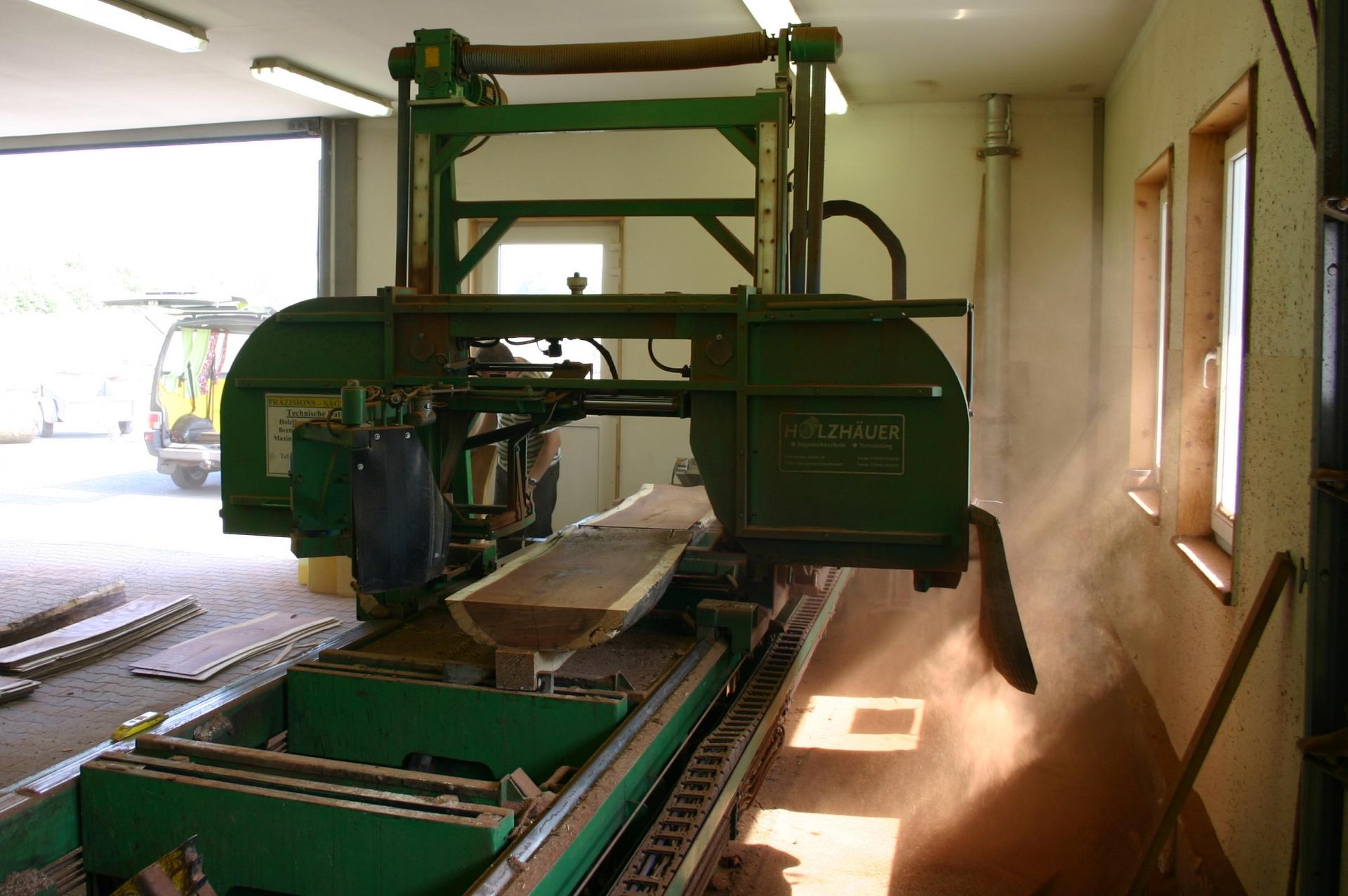
Each piece of wood is alive and has its own character, even if it comes from the same tree. As a professional guitar maker, I recognize and utilize the qualities of the material. The timing of the felling and the processing up to the raw plank have essential effects on the sound of the guitar. The optimal storage of the wood is a prerequisite for my work – I store the wood I use myself, in a controlled manner, for as long as possible. Something truly special, for example, is the split cedar that is harvested according to the phases of the moon.
When I can accompany the entire journey of a tree all the way to the finished guitar, a deep connection with the material is formed. That’s why I place great value on working with wood from local regions.
Every guitarist has a different playing technique, taste, and skill level. Therefore, each instrument is made individually for a person. During an extensive conversation, I decide which woods are suitable. After that, we go to the wood storage and select the top and back together.
In my wood storage, there are about 10 European woods … ranging from the neighbor’s plum tree to olive wood from Greece. I also have about 17 types of wood from the forests of India to South America.
Eventually, all my woods will make a musician happy in the form of a guitar.
One who can write nicely can even write nicely with a bad brush.Japanese proverb


What cannot exist together, does best to dissolve.Johann Christoph Friedrich von Schiller (1759 – 1805)
Glue
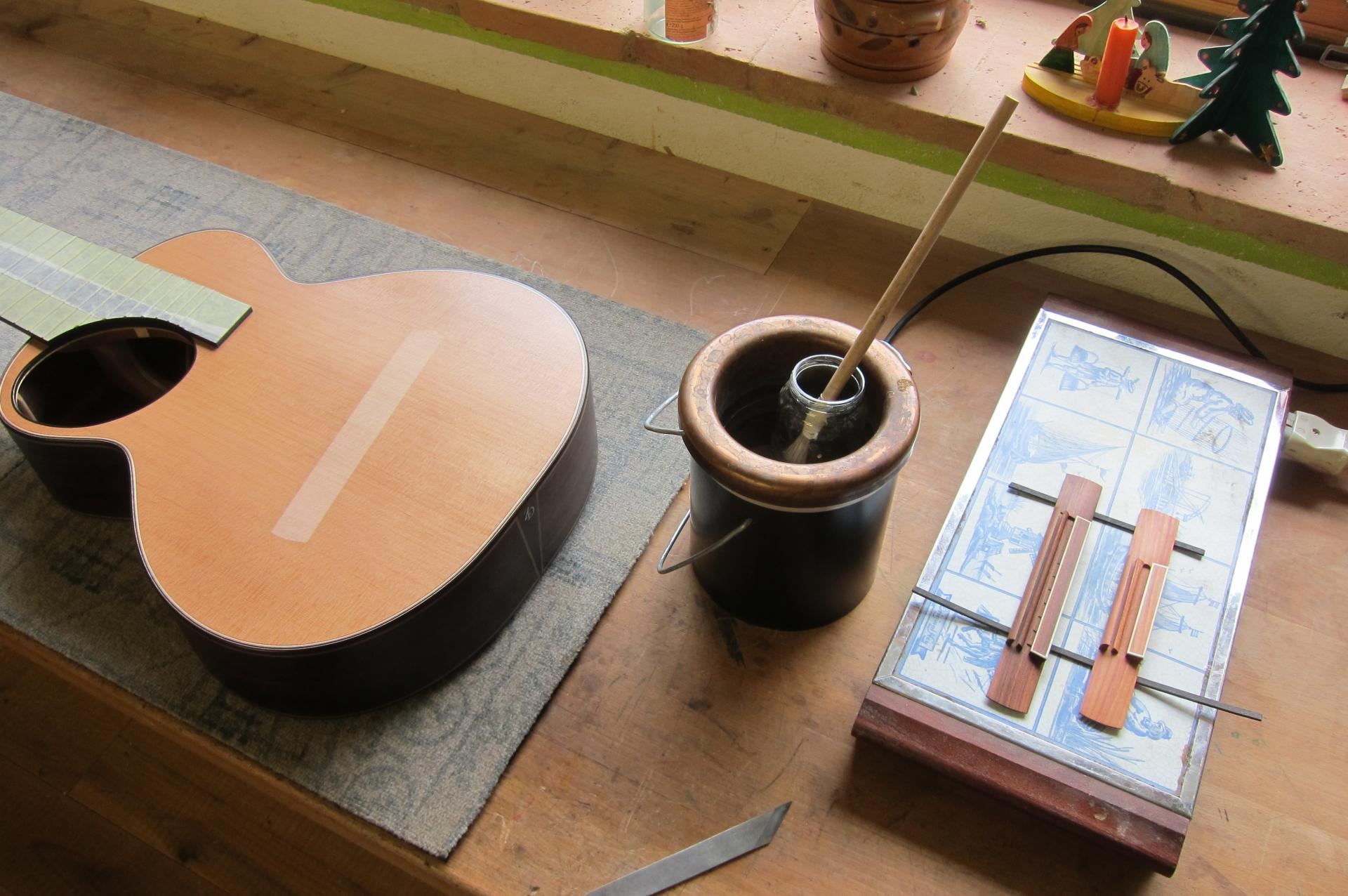
Glue also plays a major role in a musical instrument. Nowadays, in addition to traditional glues, adhesives are used to work with materials like carbon or Nomex. Nomex is primarily used in the “sandwich” construction (Doubletop) for tops, while carbon is mostly used in the neck to make it stiffer.
All glues and adhesives must, like the varnish, be elastic in order to withstand the movement of the wood and not crack. This means that the glue also dampens the vibrations of a guitar due to its elasticity. Therefore, it is very important for the guitar maker to carefully consider which components are glued or bonded with which glue/adhesive.
- Below, I list some of the glues and adhesives I use, starting with the more toxic ones:
PU Glue or PUR Glue (one-component polyurethane glue): This wood glue contains no water, which is a major advantage when gluing large surface areas and thin wood layers. Because it lacks water, the wood doesn’t shift during the bonding process. However, I would personally never use this glue for a top or a back.
Epoxy Resin Glue (2-component glue): Nowadays, in addition to wood, other materials are incorporated into a guitar. However, these materials often cannot be bonded with traditional glues. Therefore, it is necessary to use other adhesives. Epoxy resin glue is particularly useful here. It also contains no water, which is again an advantage.
White Glue (low-formaldehyde dispersion glue): White glue contains PVAc (polyvinyl acetate) as a binder, which is delivered as a dispersion in water. It is inexpensive, but in processing, it is very soft, and therefore, not a good choice for instrument making.
Titebond (aliphatic resin adhesive): This wood glue is ideal for processing nearly all types of wood. Titebond hardens very firmly after drying, thus damping vibrations less than, for example, white glue. Additionally, a joint made with Titebond is reversible, which is advantageous for restorations or repairs.
Hot Hide Glue (Animal Glue): Hide glues are water-soluble, natural adhesives that have been used for over 5000 to 6000 years and are made from animal by-products. These are boiled for hours until they form a gel (glue). Gelatin is mostly made up of glutin, which has a similar composition to gelatin. Depending on the raw material, hide glues are classified as bone glue, hide glue (leather glue), rabbit glue, fish glue, and isinglass glue. Each of these glues has different properties. Bone and hide glue are commonly used in instrument making, while rabbit glue is used especially for repairs/restorations.
To achieve good results with these glues, a lot of practice and knowledge are required.
The whole is more than the sum of its parts.Aristotele (384 – 322 B.C.)
Nuts, Saddles and Frets
Just as the tires form the connection between the road and the car, the saddles at the bridge and the top of the fretboard form the connection in a guitar. When the strings are pressed, it’s the bridge saddle and the frets that play a role. These components must be made from the right material and be perfectly crafted to allow the guitar to reach its full potential.
I use narrow, high, and rather hard frets made from a nickel-silver alloy. Depending on how much the guitar is played and how much force is applied, they will eventually wear down. When this happens, the frets must be reworked or replaced so that the strings can vibrate cleanly again and the guitar can sound as it should. With very high frets, intonation problems can quickly arise because the pitch can easily be altered with the right pressure. On the other hand, it’s also possible to consciously adjust the pitch, and vibrato becomes easier. With low frets, you have to fret directly behind the fret, but the pressure you apply to the string is not as important.
Various materials are used for the saddles. The most common are ivory, mammoth bone or tusk, whale bone, cattle bone, and plastic.
Elephant ivory has been banned for many years and is only legally obtainable with C.I.T.E.S. certification. It was used in guitar making for a long time.
Mammoth ivory is still legally available. However, it is very difficult to distinguish between mammoth and elephant ivory, which can easily lead to legal issues.
Whale bone is made from the baleen (horn plates instead of teeth) of large whales. Although this material is highly suitable, I use it just as little as ivory. Like elephant ivory, it is also subject to wildlife protection regulations.
I prefer to use cattle bone. Since bone is an organically grown material, it can have significant quality differences. I’m lucky that my sister breeds Galloway cattle. These animals grow slowly outdoors, without being fed with industrial feed. This means that the bone grows slowly and becomes very strong.
Finally, there are various artificial bridge inserts and saddles, which can also have enormous quality differences. Sometimes, a good plastic saddle is the better choice compared to bone or ivory.
By choosing the right material for the saddles, a guitar can fully unleash its potential.
Two planets meet:
A: “How are you?”
B: “Not good”
A: “Why, what’s wrong?”
B: “I got the homo sapiens”
A: “Don’t worry…that’ll pass all on it’s own!”
Summary of C.I.T.E.S. Regulations
- Summary: CITES and Environmental Protection in Austria
Many high-quality guitars use woods like rosewood or mahogany, and decorations such as ivory or tortoiseshell, which are subject to the CITES agreement (the Washington Convention). CITES lists protected species in three appendices, with Appendix I imposing the strictest trade restrictions. These rules apply in Austria and are supplemented by EU and national laws.
Musicians must pay attention to CITES regulations when buying or selling used instruments, traveling with instruments, or shipping them abroad. It is important to check if protected materials are present and to contact authorities for information.
- CITES distinguishes three categories:
Appendix I: Highest protection (e.g., Brazilian rosewood, ivory). Trade is only allowed with a CITES certificate.
Appendix II: Intermediate protection (e.g., most rosewoods except Brazilian rosewood). Since December 2019, finished instruments made from most Dalbergia and Bubinga species are exempt from permit requirements if the protected wood is less than 10 kg per instrument.
Appendix III: Protected in at least one country; mostly irrelevant for guitarists.
For instruments with Appendix I materials, strict permit requirements apply. Trade is only possible with special CITES certificates, issued in the name of the owner.
For non-commercial travel with Appendix I instruments, a Musical Instrument Certificate (MIC) can be requested, allowing multiple cross-border trips. A negative certificate may be needed to prove legal origin, especially for travel to the USA.
When crossing borders with CITES materials, always use the red customs channel and present all documents. Even minor protected components (like an ivory saddle) can result in confiscation.
Since 2017, both owner and holder can be listed on CITES certificates, facilitating legal use of loaned instruments.
A “Declaration of Materials” is a written statement detailing the materials used, serving as proof during travel, sales, or inspections. It is recognized by Austrian authorities.
If uncertain about materials, consult a certified expert. Instruments or materials acquired before protection status (“pre-Convention”) or considered antiques may be exempt from some restrictions.
In Austria, the Federal Ministry of Agriculture, Regions and Tourism (BML) handles CITES applications, which can be submitted online.
- For buying/selling used instruments:
Appendix I: Only with a valid, personal CITES certificate (non-transferable).
Appendix II/III: No permit needed within the EU, but proof of legal origin is mandatory.
Replacing protected materials with legal alternatives is permitted and should be documented.
Accurate documentation (serial numbers, material details, photos) is strongly recommended.
For more information, consult the official CITES website or the Austrian authorities. Regulations may differ by country; always check with your national CITES authority.
- Disclaimer:
This summary provides a brief overview. It is strongly recommended to read the full document for all details and legal requirements.