
Top woods:
I use Alpine spruce, preferably harvested at the right time of year and during the appropriate moon phase – this is especially important to me. As an alternative, I also offer Canadian cedar.
Backs & Sides:
For backs and sides, I use many local wood species such as maple, plum, service tree, and others.
Materials listed in CITES Appendix I (e.g., Brazilian rosewood) are of course only used with a valid CITES certificate.
Woods I use include:
– Maple
– Apple
– Plum
– Ash
– Pear
– Cherry
– Serviceberry
– Yew
– Cypress
– Olive
– Amaranth
– Bubinga
– Cocobolo
– Eldorado rosewood
– Honduras rosewood
– Brazilian rosewood (CITES certificate)
– Indian rosewood
– Santos rosewood
– Kingwood
– Mahogany
– Macassar ebony
– Mango
– Padouk
– Palo Escrito
– Tineo
– Zebrawood
– Wenge
– Ziricote
Necks:
For the neck of a guitar, I use materials such as:
– Maple
– Flamed maple
– Alder
– Walnut
– American walnut
– Cedro
– Mahogany
Fingerboards:
For fingerboard materials, I use, among others:
– Plum
– Ebony
– Ziricote
– Rosewood
Tuning Machines:
I install whatever is requested – most customers choose Scheller tuning machines, a German manufacturer known for outstanding quality.
Finishes:
I finish the soundboard either with shellac or a matte coating.
The rest of the guitar can be high-gloss, matte, or waxed upon request.
The matte finish is usually polyurethane – it is durable, understated, and pleasant to the touch.
Rosettes:
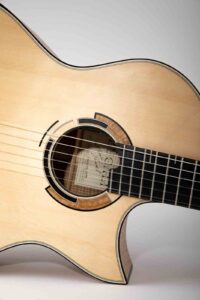
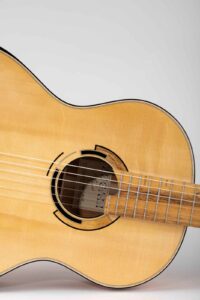
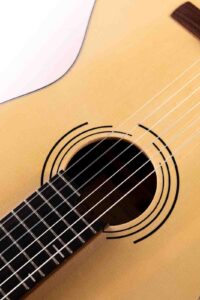
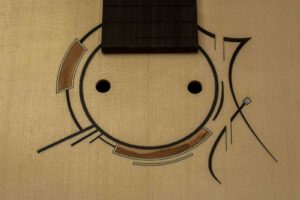
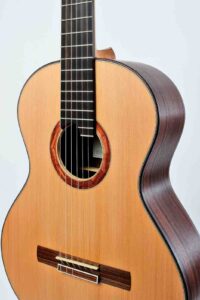
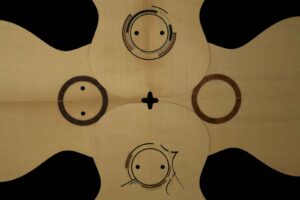
I craft my rosettes individually from the woods used for each specific guitar.
Currently, I offer four different designs.
Inspection Port:
I have been incorporating inspection ports for quite some time – they are secured with screws and are located either centrally on the side.
The idea isn’t new, but more and more luthiers are now relying on this practical solution.
Top Bracing:
I build my own classical bracing and a complex, three-dimensionally designed lattice bracing system. For the Jazzabella, I opted for parallel bracing.
So far, I have not implemented double-top bracing for various reasons.
Pickups:
I generally install whatever is requested – I especially enjoy working with Udo Roesner, who also offers me custom-made pickups.
Strings:
There are many options when it comes to strings as well.
Currently, I mainly play and use:
– Savarez 510 MRP
– Savarez 510 AJP
Ultimately, string choice is a matter of personal taste – every guitar responds differently, and every player finds their own favorites over time.
Saddle & Nut:
I work with different types of bone:
– Camel
– Water buffalo
– Galloway
Alternatively, I also use Graph Tech TUSQ or carbon.
Cutaway:
The Florentine cutaway is standard on the Crossover and Jazzabella models.
It is also available on other models upon request.
Bevel / Armrest:
My bevels are subtle but effective – providing better playing comfort without disturbing the guitar’s contour.
Number of Frets:
By default, my guitars have 20 frets.
More or fewer frets are of course also possible – entirely according to your preference.
Fret Material:
I use nickel silver for the frets.
Number of Strings:
I usually build 6-string guitars.
Multi-string guitars are also possible upon request.
Fanned Frets / Multiscale:
I’m happy to build multiscale or fanned-fret guitars – just get in touch with me about it.
String Attachment at the Bridge:
I prefer the double-hole drilling method because it clearly defines the string path.
Other techniques are also possible – depending on your preference.
Glue:
For the soundboard construction, I primarily use a mixture of bone glue and hide glue.
However, if someone prefers not to use animal-based glue, I have a very good alternative available.
Fingerboard Inlays / Side Dots:
I use all kinds of bone, various woods, mother-of-pearl, and more.
Side dots are standard; fingerboard inlays can be custom-designed upon request (additional cost depending on work involved).
Left-Handed:
Available upon request (no extra charge).
*Vegan guitars are easily possible upon request.